General
Automated Catalyst Characterization System
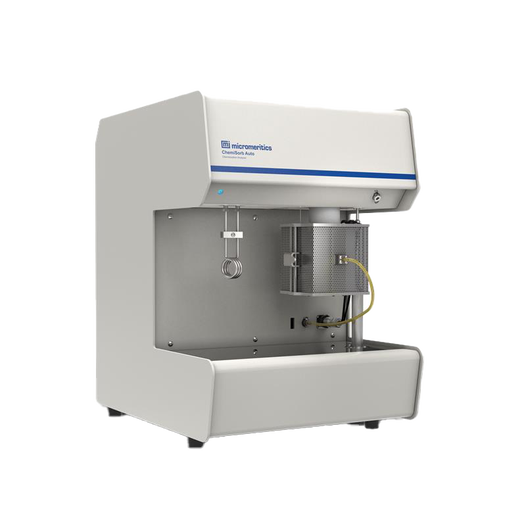
The Micromeritics ChemiSorb Auto is a compact, fully automated chemisorption analyzer designed to deliver high-precision, repeatable results for heterogeneous catalysts.
Whether you’re conducting temperature-programmed experiments or pulse chemisorption analyses, the ChemiSorb Auto offers reliable performance, affordable access, and unmatched ease of use – all in a benchtop footprint.
Results no rival can match
ChemiSorb Auto is redefining routine chemisorption analysis with a compact, automated benchtop solution that delivers high-performance results—without the complexity or cost of traditional systems. Designed for labs that demand reliability and efficiency, ChemiSorb Auto empowers researchers in both academic and industrial settings to qualify catalysts and conduct TPx experiments with confidence.
Chemisorption Catalyst Characterization
Chemisorption is a surface-specific process where adsorbate molecules undergo chemical reactions with solid surfaces, forming strong, often irreversible bonds through electron sharing. This high-energy interaction is essential for catalyst characterization, offering insights into activation temperatures, available surface metal, site strength, and performance across redox cycles. Available tests:
Temperature Programmed Reduction (TPR)
- Catalyst activation behavior
- Max reduction rate
- Quantitative hydrogen consumption
Temperature Programmed Oxidation (TPO)
- Evaluate catalyst regeneration
- Characterize carbon deposits
- Study redox properties
Temperature Programmed Desorption (TPD)
- Characterize acid and base sites
- Isosteric heat of adsorption
- Evaluate binding affinity
Pulse Chemisorption
- Number of active sites
- Metal dispersion
- Active metallic surface area
- Crystallite size
Features
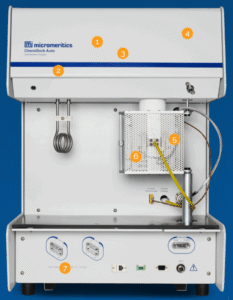
1. Loop Pressure Measurement
Exact quantities of gas dosed to the sample are known, ensuring repeatability within +/-1%.
2. Minimal Internal Gas Volume
Assures high resolution, fast detector response, and reduces error when calculating gas volumes.
3. Patented Blending Valve
Allows precise gas blending and multi-point automatic gas calibrations.
4. Highly Sensitive Linear Thermal Conductivity Detector (TCD)
Assures the calibration volume remains constant over the full range of peak amplitudes so the area under the peak is directly proportional to the volume of gas reacted.
5. Forced Air Cooling
Cools the furnace temperature rapidly down to near ambient (500°C to 50°C in 30 minutes), reducing analysis time and increasing throughput.
6. Dynamic Clamshell Furnace
Provides temperature control up to 1000°C and controlled heating from 1 to 100°C at a linear rate with minimal temperature overshoot.
7. 8 Total Gas Inlets
Four each for carrier and loop gases fed to the system with two high-precision mass flow controllers.
8. 3rd Party Safety Tested and Approved
CE Certified with NRTL marking and CB scheme validation, ensuring high quality and operator safety
Options
MASS SPECTROMETER (MS)
Mass spec provides a direct probe for the identity and quantity of specific reaction products. This is especially valuable when investigating an unknown reaction, or a reaction that creates multiple products
The single quadrupole mass spec with heated transfer line provides detection of mass fragments up to 200 amu and data collection that is integrated with the operation of the ChemiSorb Auto.
The ChemiSorb Auto also includes a general mass spec communication port for coordination with a lab’s existing mass spec
CRYOCOOLER
Begin experiments at temperatures as low as -100 °C with controlled liquid-nitrogen-based cooling